
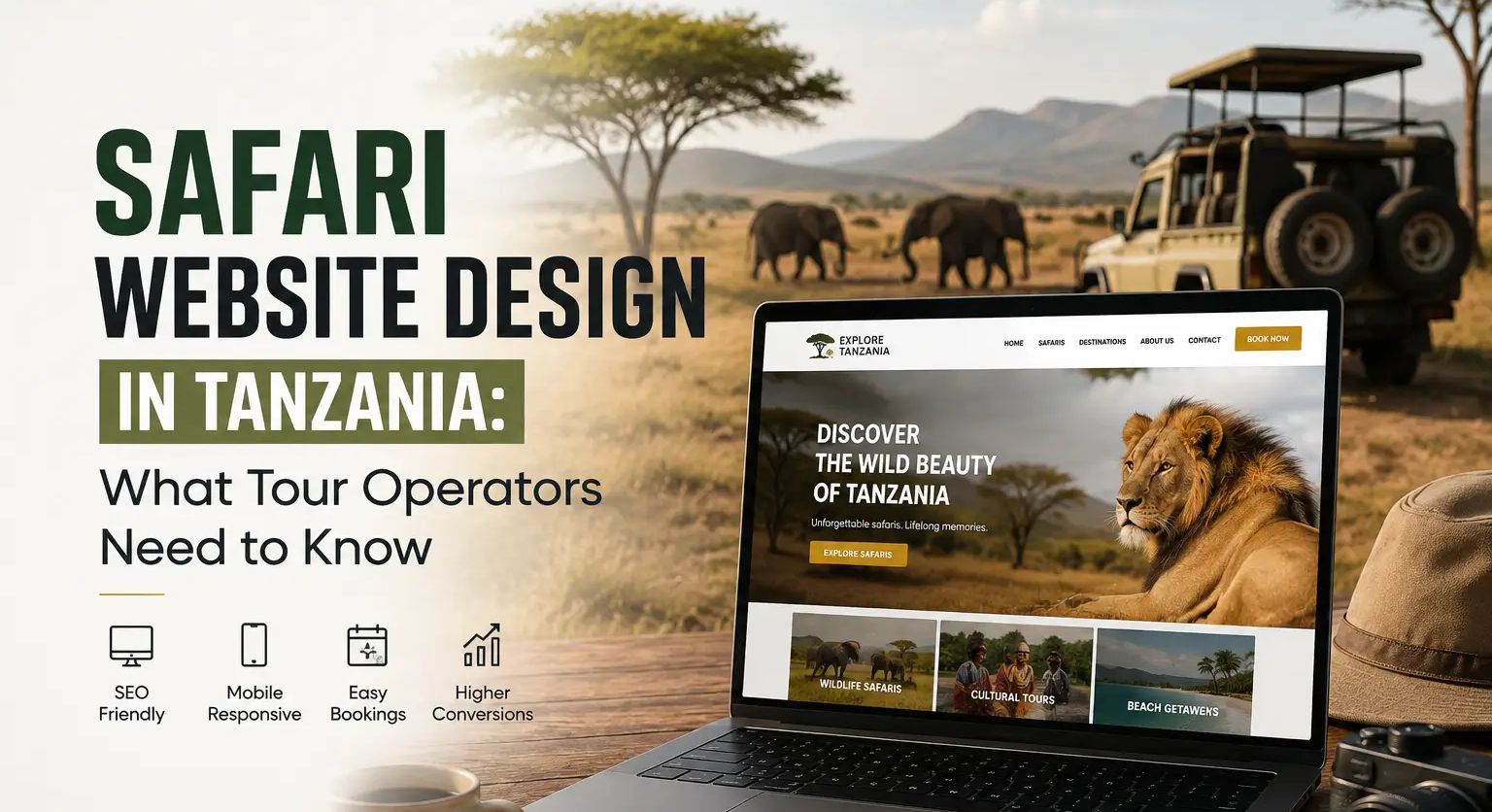
Most safari websites in Tanzania are quietly losing bookings. Here's why, and exactly what tour operators need to fix it, from mobile speed to AI search visibility.
A tourist in Germany is lying in bed at 11pm, scrolling through five different Tanzania safari websites on their phone. Four of them take too long to load. One shows broken images. Another has a "Book Now" button that goes nowhere. By the time they find a site that actually works, they've already forgotten which company you are.
This happens every single day. And most tour operators never find out it happened, because a lost visitor doesn't send you an email to tell you why they left.
If you run a safari or tour company in Tanzania, your website is not a brochure. It's your busiest sales agent, the one working 24 hours a day while you're out on a game drive with no signal. The problem is that most safari websites in Tanzania were never built to sell. They were built to exist.
Let's talk about why that's costing you bookings, and what actually needs to change.
The Real Cost of a Weak Safari Website
Before getting into fixes, it's worth being honest about what a bad website actually does to a tour business.
It kills trust before you get the chance to build it. International travelers are about to hand over thousands of dollars and trust a stranger with their safety in a foreign country. If your website looks outdated, loads slowly, or feels generic, that doubt sets in immediately and it doesn't matter how good your actual safaris are.
It sends free traffic straight to competitors. Every visitor who bounces off your site because it's slow or confusing doesn't just disappear. They open a new tab and search again. Often they land on a competitor with a smoother experience, even if that competitor runs a worse safari than you do.
It makes your marketing budget less effective. If you're running Meta ads or ranking on Google but sending that traffic to a weak website, you're paying to bring people to a leaky bucket. The click costs the same whether the site converts or not the difference is whether that spend turns into revenue.
Common Mistakes on Tanzanian Safari Websites
Having audited websites across the tourism sector in East Africa, the same problems show up again and again.
1. Slow Load Times on Mobile
Most safari inquiries start on a phone, often on inconsistent connections, a tourist checking options from a hotel Wi-Fi in Arusha or a traveler browsing on data in Europe. If a site takes more than three seconds to load, a large share of visitors simply leave before they see a single photo of the Serengeti.
Heavy, uncompressed images are usually the culprit. A website built with beautiful, high-resolution safari photography is a good instinct but if those images aren't optimized, that same photography becomes the reason people never see it.
2. No Clear Path to Inquiry or Booking
Some safari websites bury their contact information in a footer, or worse, only offer a generic "Contact Us" page with no urgency and no clear next step. A visitor who is excited about a 7-day Serengeti and Ngorongoro package should never have to hunt for how to ask about it.
Every page, not just the homepage needs an obvious, low-friction way to start a conversation: a WhatsApp button, an inquiry form tied to a specific package, or a clear phone number.
3. Missing Trust Signals
International travelers researching Tanzania safaris are often comparing five or six operators before deciding. What separates the one they choose from the one they forget?
- Real client reviews and testimonials, not just star ratings
- Licensing and association memberships (TATO, TALA, etc.) clearly displayed
- Actual photos from real trips, not generic stock imagery
- Team or founder story, a face and a name behind the business
- Safety and vehicle information, especially for self-drive or off-road-heavy itineraries
A site missing these signals reads as risky, even if the operator is completely legitimate.
4. Generic, Templated Design
There are only so many free templates in circulation, and travelers researching safaris see dozens of tour websites in a single search session. When several competing operators are using near-identical templates with swapped logos, none of them stand out and price becomes the only differentiator left, which is a losing game for smaller operators.
5. No SEO Foundation
Many safari websites in Tanzania are never actually built to rank. Title tags are left as generic defaults, there are no location-specific pages (Serengeti safari packages, Ngorongoro day trips, Zanzibar add-ons), and there's no content structure that search engines can understand. This means operators depend entirely on paid ads or word of mouth, while competitors with SEO-optimized sites capture free, ongoing traffic from people actively searching to book.
6. Invisible to AI Search
This is the newest and most overlooked problem. Travelers are increasingly asking tools like ChatGPT, Google's AI Overviews, and Perplexity questions like "best safari company for a family trip to Tanzania" or "how much does a 5-day Serengeti safari cost." These AI systems pull answers from websites that are structured clearly, answer specific questions directly, and carry credible, well-organized information.
A website that isn't built with this in mind simply doesn't get mentioned. Your competitors' names show up in the AI-generated answer. Yours doesn't, not because your safaris are worse, but because your website was never structured to be understood by these systems in the first place.
What a Website That Actually Converts Looks Like
Fixing this isn't about a total reinvention. It's about building with intent, from the ground up, around how people actually research and book a safari today.
Fast, mobile-first performance. Compressed imagery, clean code, and a layout designed for a phone screen first not a desktop layout squeezed down.
A clear booking or inquiry journey. Every package page should answer "what's included, what does it cost, and how do I ask about this" without the visitor having to search for it.
Real trust signals throughout. Reviews, licensing, team photos, and genuine trip photography placed where decisions are actually being made not buried on an "About" page nobody visits.
Content built for search, not just for looking nice. Dedicated pages for specific destinations, trip types, and traveler questions, using the language your actual customers search for in English and, where relevant, targeting the regional and international phrasing travelers use.
Structure built for AI search visibility (GEO). Clear, direct answers to common questions, well-organized headings, schema markup, and content that's easy for AI tools to pull from and cite, so when someone asks an AI assistant about safaris in Tanzania, your business is part of the answer.
A design that reflects the actual experience. Photography, story, and tone that capture what a trip with your company actually feels like not a template that could belong to any tour operator anywhere in the world.
Why This Matters More?
The way people research trips has shifted. It's no longer just a Google search followed by five browser tabs. Travelers are asking AI assistants direct questions and taking the first few recommendations seriously. Search engines themselves are increasingly generating direct answers instead of just a list of blue links.
Tour operators who treat their website as a static digital brochure are going to become progressively less visible not because they did anything wrong, but because the ground shifted under a website that was never built to move with it. The operators who invest now in a website built for speed, trust, search, and AI visibility are the ones who will keep showing up in front of travelers over the next several years, while competitors quietly fade out of the results.
Frequently Asked Questions (FAQs)
How much does it cost to build a professional safari website in Tanzania?
Costs vary depending on scope, but a well-built site with SEO foundations typically costs far less than a single month of underperforming ad spend and keeps generating inquiries long after it's built.
Do I need a new website, or can my current one be fixed?
It depends on the foundation. Sites with fundamentally slow hosting or outdated structures are often better rebuilt, while sites with a solid base can sometimes be optimized for speed, SEO, and conversion without a full rebuild. An audit is the fastest way to know which situation you're in.
What is AEO and GEO, and why does it matter for a tour company?
AEO (Answer Engine Optimization) and GEO (Generative Engine Optimization) refer to structuring your website so that AI tools like ChatGPT, Google AI Overviews, and Perplexity can understand, trust, and recommend your business when travelers ask trip-planning questions. As more travel research moves to AI assistants, this determines whether your business gets recommended at all.
How long does it take to see results after a website redesign?
Speed and user experience improvements are immediate. SEO and AI search visibility typically build over 2–6 months as search engines and AI tools re-index and recognize the new structure and content.
Your website should be closing bookings while you sleep not losing them.
Fursaflix Digital builds fast, mobile-first, SEO-and-AI-search-ready websites for tour operators across Tanzania. If you're not sure whether your current site is helping or quietly costing you bookings, GET A FREE WEBSITE AUDIT FROM OUR WEBSITE DESIGN TEAM and see exactly what's working and what isn't.